
Tower Lab Towers Hub
Twenty named cubes, physics jobs, and the pages that turn a hand into a knockoff machine.
Tower Lab is a single-player physics roguelite tower defense from Devon Powell and Xueer Zhu. Steam Early Access is scheduled for September 7, 2026 on Windows and macOS. Robots have no health bars. You spend Energy to play cubes from your hand, place them in open space, and knock the wave off the lab before it reaches the exit. This hub is the map of every playable tower heading into that launch.
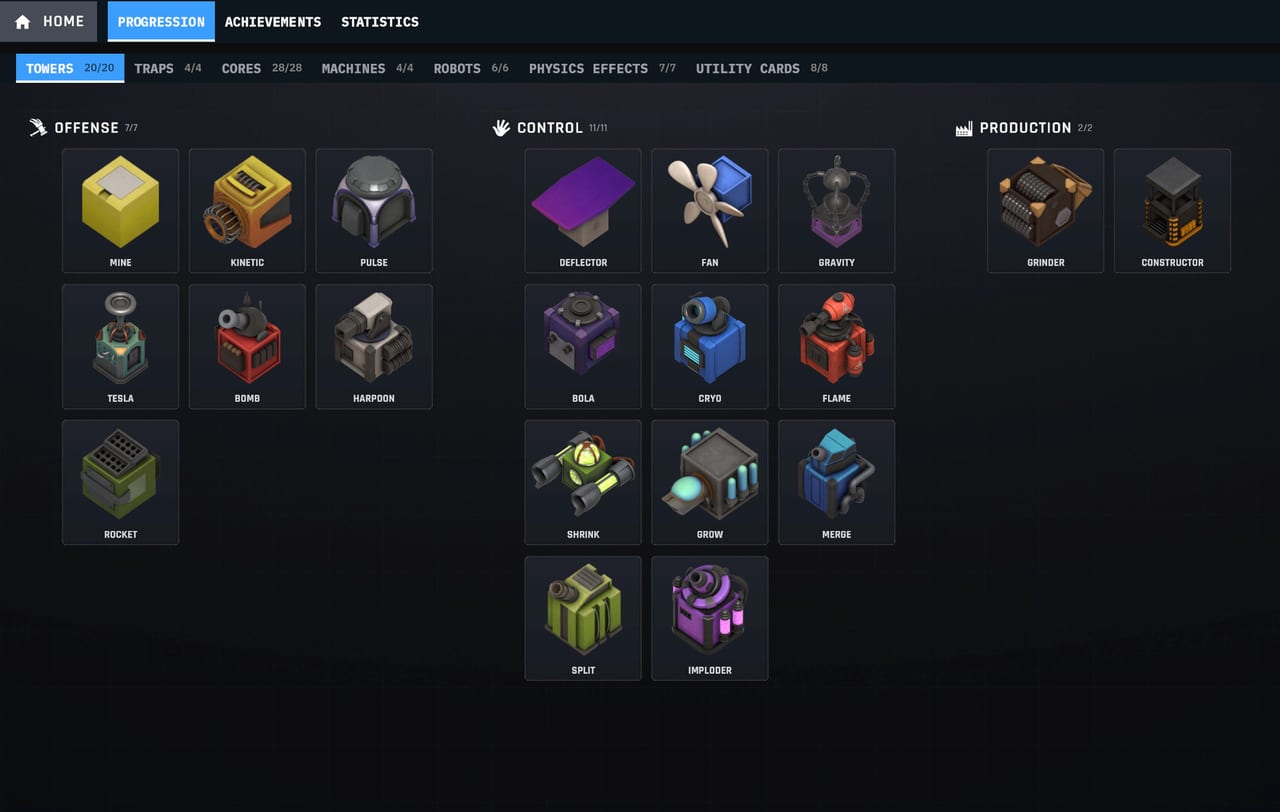
Early Access is targeting 20 towers, each with its own tech tree and more than 150 upgrades. The public demo collection already listed Towers 20/20. Treat that roster as the launch set: seven offense cubes, eleven control cubes, and two production cubes. Do not look for extra names on this wiki. If a cube is not in the tower roster, it is not part of the confirmed twenty.
What these pages are for
Start with the full tower roster when you need a role for every cube. Open tower synergies when you want Fan plus Gravity, Shrink then Fan, Tesla on copper, or a Grinder conveyor. Use upgrades and tech trees for Tech Points, stackable modules, refunds, and the Tesla Double Strike example. Rank last. The tower tier list is a pre-launch, demo-informed ranking, not an official balance patch.
The cubes only make sense next to Matter, Energy, and Tech. Matter (M) is the shop currency you farm by knocking robots, with grown bodies paying more. Energy (the lightning icon) is what you spend from your hand each wave. Tech Points (T) buy modules on a placed cube. New players should pair this hub with how to play and physics basics before they chase a ranking.
The 20-cube roster
Offense is Mine, Kinetic, Pulse, Tesla, Bomb, Harpoon, and Rocket. These cubes apply knockback, explosives, hooks, or arcs. They still obey physics: a Tesla zap that hits rubber is a weaker shove, and a Rocket that you Grow becomes a heavier projectile instead of a bigger damage number.
Control is Deflector, Fan, Gravity, Bola, Cryo, Flame, Shrink, Grow, Merge, Split, and Imploder. This is the largest group because Tower Lab is a control game. Gravity orbits enemies and projectiles. Fan adds a directional gust. Shrink makes knockoff easier. Grow raises Matter and risk, and it also scales projectiles. Split cuts mass in half and leaves a copy. Deflector redirects paths.
Production is Grinder and Constructor. Grinder turns robots into Scrap and wants a Conveyor Line off its output. Constructor is the factory partner that grows the lab instead of shoving a single target. Economy cubes do not replace a knockoff plan. They feed the plan.
How towers actually win waves
Towers combo through real physics, not scripted set bonuses. A Gravity well that holds a Pulse, a Fan that spirals that orbit, and a Shrink that lightens the cluster is one machine. An isolated high-rank cube with no partner is often worse than two modest cubes that share a job. That is why this hub sends you to synergies before the tower ranking.
Placement is free in open space. You can move cubes. Build a line toward an edge, a spiral over a pit, or a bounce corridor with Deflectors. Then press Start Attack and watch mass, friction, conductivity, and temperature decide the wave.
Upgrades, cores, and ranking
Each cube has a tech tree you buy with Tech Points. Modules can stack. Tesla’s official video shows Double Strike adding targets and a chain-to-nearby upgrade that also stacks. You can refund and you can ask the UI to suggest an upgrade. Details live on the upgrades page.
Cubes are only half a loadout. Early Access is targeting 26 player cores, 14 Hazard Cores, five machines, seven traps, eight utility cards, and seven physics-effect cards. The demo collection snapshot showed Towers 20/20, Traps 4/4, Cores 28/28, and Machines 4/4. Use the store counts as the launch target and read cores and machines before you treat any cube rank as a full build.
Campaign, Standard TD, Endless, Puzzle, and Workshop all use this same roster. Campaign is the roguelite spine across three regions. If you are planning a first run, pair the roster with starter decks and the Early Access notes.
Tower Lab is not a Roblox experience. You are one operator on a floating lab. The fun is chaining twenty named cubes into a contraption that throws robots into the void.
When you finish this hub, open the tower roster and pick one offense cube, one control cube, and a production plan. Then read synergies so those three pieces share a physics job before the first Vend-O-Lab shop.
Frequently Asked Questions
Quick answers for new Tower Lab players.
How many towers are in Tower Lab?
Early Access is targeting 20 playable towers. The demo collection already listed Towers 20/20. See the tower roster for every name in offense, control, and production.
Do Tower Lab enemies have health bars?
No. There is no damage number. Cubes push, pull, bounce, grow, shrink, and fling robots off the map, as explained in physics basics.
Should I read synergies or the tier list first?
Read tower synergies first. The tower tier list is a demo-informed ranking, and combos beat an isolated high rank.
What currencies sit next to the towers?
Matter (M) buys cards in the shop, Energy (lightning) plays cubes from your hand, and Tech Points (T) buy modules on the upgrades and tech trees page.
Is Tower Lab out yet?
Steam Early Access is scheduled for September 7, 2026. Confirm the date on the Early Access page.