
Tower Lab Starter Decks
Named openers that do not assume Tesla is sitting in the first Vend-O-Lab.
A starter deck in Tower Lab is a physics sentence you can still say after the first shop rerolls against you. Steam Early Access is scheduled for September 7, 2026. These three named plans use real towers from the twenty-card roster and one real trap. They are not loadouts you download. They are jobs: make robots light, throw them, or grind them toward a pointed edge.
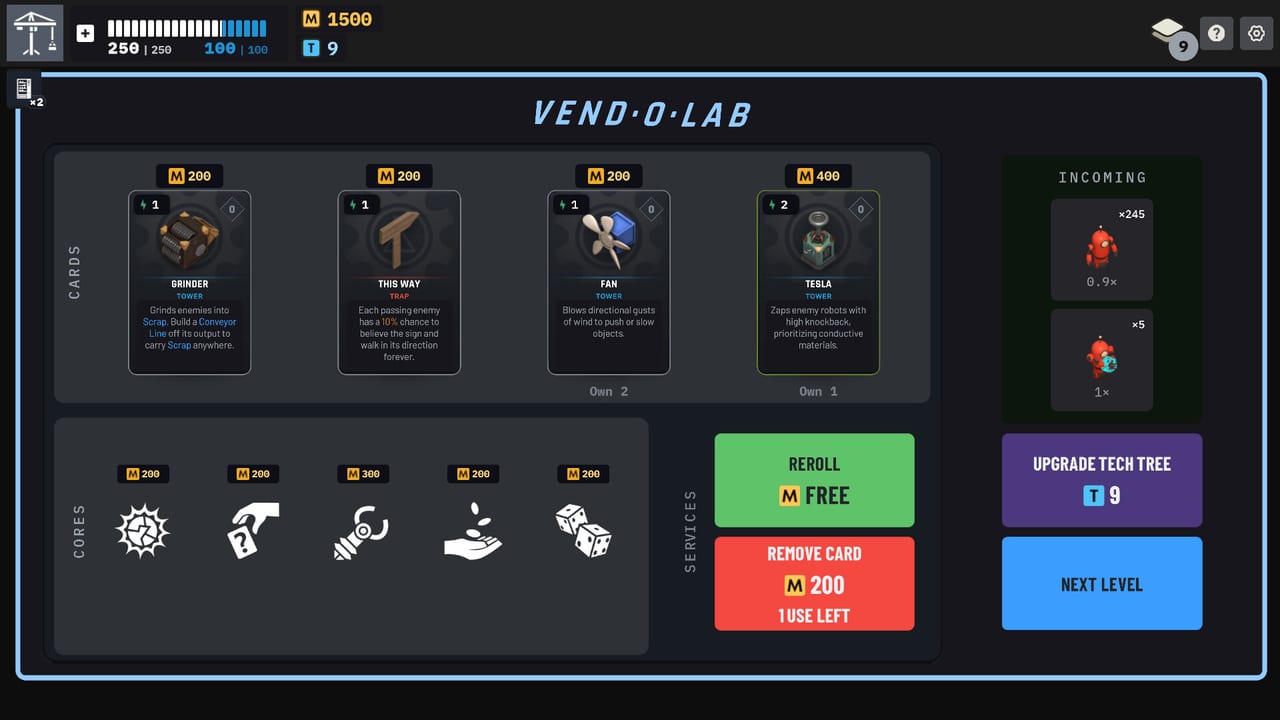
Region 1 note, because this trips demo veterans: a patch removed Tesla, Salvage, and Hot Swap from the starting deck. Do not build your first ten minutes around an electrical carry that might not be in the opening hand or the first Vend-O-Lab. Tesla still exists. It is a M400-class buy in example shop screenshots, not a guaranteed Region 1 tutor card. Wind Orbit and Scrap Line open without it. Conductive Knockback is the plan you pivot into when Tesla actually appears.
Read the tower roster for what each tool does, then tower synergies for why the pairs collide. The campaign walkthrough tells you which mode you are drafting for. Come back to the builds hub when you need the Matter budget that pays for these shops.
Why named physics plans beat random shops
The loop is energy, Matter, and tech points. Energy plays the card. Matter (M) buys the next card, a reroll, a removal, or a tech-tree node. Tech points (T) deepen one tower instead of widening the deck. If you buy whatever is cheapest, you collect verbs that argue: a Grow that fattens robots you then cannot Fan off the map, a Shrink that starves the shop, a Kinetic that shoots the wrong way because you never placed a Deflector.
Named plans constrain the shop. When the Vend-O-Lab shows Grinder at M200, This Way at M200, Fan at M200, and Tesla at M400, you already know which sentence you are finishing. Rerolls can be free, so a blank shop is not a crisis. Remove-card at M200 with limited uses is the real scarce resource: spend it on the card that fights your sentence, not on the card you merely dislike.
Place in any open space and move freely. The opener is a layout as much as a deck. Wind Orbit wants a well near an edge. Scrap Line wants a corridor. Conductive Knockback wants a bounce lane. If you drop all three towers on the spawn portal, you have a pile, not a plan.
Wind Orbit: Fan, Gravity, and Shrink
Wind Orbit is the cleanest Region 1 sentence. Fan applies directional force. Gravity captures bodies into an orbit. Shrink reduces size and mass so the same gust and the same well can finish the job. You are not waiting for a kill animation. You are reducing the work required to reach the void.
How to place it: Shrink first contact so the wave is cheap to move, Fan to aim the cheap bodies, Gravity to hold stragglers and fling them when the orbit clips an edge. If the well sits in the center of a wide pad, robots loop forever and leak through the exit. Pull the Gravity tower toward a corner. Move it between waves. The HUD lets you Move Tower and Focus Cam with F; use both instead of buying a second Gravity because the first one is in a polite location.
Shop priority: Fan at M200 is an example staple. Extra Shrink copies are usually better than a random Bomb. Grow is the enemy of this plan unless you are deliberately farming; see Matter farming before you greed. Tesla is optional spice, not the engine. If Region 1 withholds Tesla, Wind Orbit does not care.
Fail case: you Shrink so hard that Matter income collapses, then you cannot afford the next Fan. Leave one lane of medium robots if the shop is dry. Fail case two: you place Gravity uphill of the Fan so the well fights the wind. Aim both at the same edge.
Conductive Knockback: Tesla, Fan, and Deflector
Conductive Knockback is the mid-run electrical sentence, not the default opener. Tesla arcs and shoves. Fan turns that shove into a lane. Deflector bounces bodies that the arc did not finish. Copper-style heavy units in older playtests took extra electrical knockback; Rubber-style units ate it. Treat enemy shells as a reason to keep the Fan and Deflector, not a reason to spam only Tesla.
Because Tesla, Salvage, and Hot Swap left the starting deck, you may not see Tesla until a later shop. Do not reroll your entire Matter pool on Region 1 hoping for it. Play Wind Orbit or Scrap Line, bank M400, and convert when Tesla appears. Example screenshot pricing put Tesla at M400 against Fan at M200; that gap is the whole Region 1 lesson.
How to place it: Tesla covering the approach, Deflector on the far side of the pad to bounce survivors toward an edge, Fan to keep the bounce from becoming a parking lot. Right-click a placed Tesla to open tower info and its tech tree; spend T on extra arcs or chain behavior only after the lane exists. A Tesla with a fat tree and no Deflector is a sparkler.
Fail case: you buy Tesla and then fill the deck with other premium cards until energy cannot play the Fan. Conductive Knockback needs the cheap wind card in hand, not a museum of electrical upgrades.
Scrap Line: Grinder, Constructor, and This Way
Scrap Line is the contact plan. Grinder is a M200-class tower in example shops. Constructor belongs to the same mechanical family: bodies, parts, and extra objects on the pad. This Way is a trap, also shown at M200, that aims traffic. Together they make a corridor. Robots do not need to be light. They need to be pointed at teeth, then pointed off the map.
How to place it: This Way first so the path is a sentence, Grinder on the forced line, Constructor where leftover mass can be reused instead of clogging the teeth. You are allowed to move all of this. If the wave preview shows a fat pack, slide the trap so the pack hits the Grinder at an angle instead of head-on. Incoming wave preview exists so you do this before you click Start Attack.
Shop priority: a second This Way can be worth more than a random Rocket. Remove-card at M200 is how you delete a Shrink that keeps starving the Grinder of mass. Scrap Line likes Matter-rich bodies; it is the plan you pick when you intend to Grow for payout and still clear.
Fail case: you buy Grinders with no trap, then wonder why robots walk around the teeth. Fail case two: you treat Constructor as a damage turret and park it off the line. If it is not feeding or reshaping the corridor, it is a wasted energy slot.
Region 1 shop reality
Vend-O-Lab is buy, reroll, remove, upgrade tech, next level. Example prices: Grinder M200, This Way M200, Fan M200, Tesla M400. Reroll can be free. Remove is limited. Wave preview sits on the same screen for a reason: do not upgrade a tech tree you will not use on the next pack.
Region 1 is a teaching shop, not a complete catalog. The campaign walkthrough covers how regions escalate. If your opening hand looks “wrong,” it is often because you still expect the old Tesla start. Pick Wind Orbit or Scrap Line from the cards you actually have. Salvage and Hot Swap were also pulled from that start; do not plan your first energy curve around those utilities until they show up again.
Standard TD lets you spend Matter mid-wave, so a starter deck in that mode is allowed to buy the missing Fan while robots are still on the pad. Campaign is stingier: the shop is a between-stage event. Endless weekly maps such as Overmass punish a Wind Orbit that never learned to handle grown mass; keep Scrap Line in your pocket.
How to pivot after the first Vend-O-Lab
Pivot rules:
- If you see Fan and Shrink, you are in Wind Orbit even if Gravity is late.
- If you see Grinder and This Way, you are in Scrap Line even if Constructor is late.
- If Tesla appears and you have M400 plus a Fan, you may convert to Conductive Knockback and remove the cards that fight the bounce lane.
- If the shop is all Grow and Merge, do not force Wind Orbit; farm on purpose or reroll.
- If energy cannot play your engine card, remove a vanity tower before you buy another one.
Tech points are for the engine, not the souvenir. Right-click the tower you actually placed, not the one you hope to find. The upgrades guide is the spending list; this page is the sentence you are upgrading.
When Early Access unlocks on September 7, 2026, run each named plan once in Campaign Region 1 and once in Standard TD. Note which shop prices moved. Note whether Tesla is still absent from the start. Then rewrite only the plan that leaked, instead of throwing the whole deck into the reroll button. Starter decks in this lab are short physics sentences. Keep them short until the edge agrees.
Frequently Asked Questions
Quick answers for new Tower Lab players.
Which starter deck should I play on Region 1?
Wind Orbit (Fan, Gravity, Shrink) or Scrap Line (Grinder, Constructor, This Way). A patch removed Tesla from the starting deck, so do not wait for Conductive Knockback on the first shop. Details sit on this page and the tower roster.
Is Tesla gone from the game?
No. Tesla is still one of the twenty towers. It was removed from the Region 1 starting deck along with Salvage and Hot Swap. Treat it as a later Vend-O-Lab buy, often at a premium like the M400 example, then chain it using tower synergies.
What is This Way if it is not on the tower list?
This Way is a trap card, shown around M200 in example shops. Scrap Line uses it to aim robots into Grinder and Constructor. Traps sit beside towers in the Vend-O-Lab, not on the twenty-tower roster.
Do these plans work in Endless and Puzzle?
The same physics applies, but Endless weekly maps such as Overmass inflate mass, which favors Scrap Line over a shrink-only Wind Orbit. Puzzle wants a clean machine. Pick the mode first in the campaign walkthrough.
Should I reroll until I see Tesla?
Usually no. Rerolls can be free, but Matter spent chasing one card delays Fan, Grinder, and remove-card. Build the plan you can place now, then convert if Tesla arrives.
Where do I learn the rest of the twenty towers?
Open the tower roster and the builds hub. Rank them later on the tower tier list once you have a sentence, not a shopping addiction.