
Tower Lab Physics Basics
No health bars. Mass, materials, grow, shrink, and knockback decide who leaves the lab.
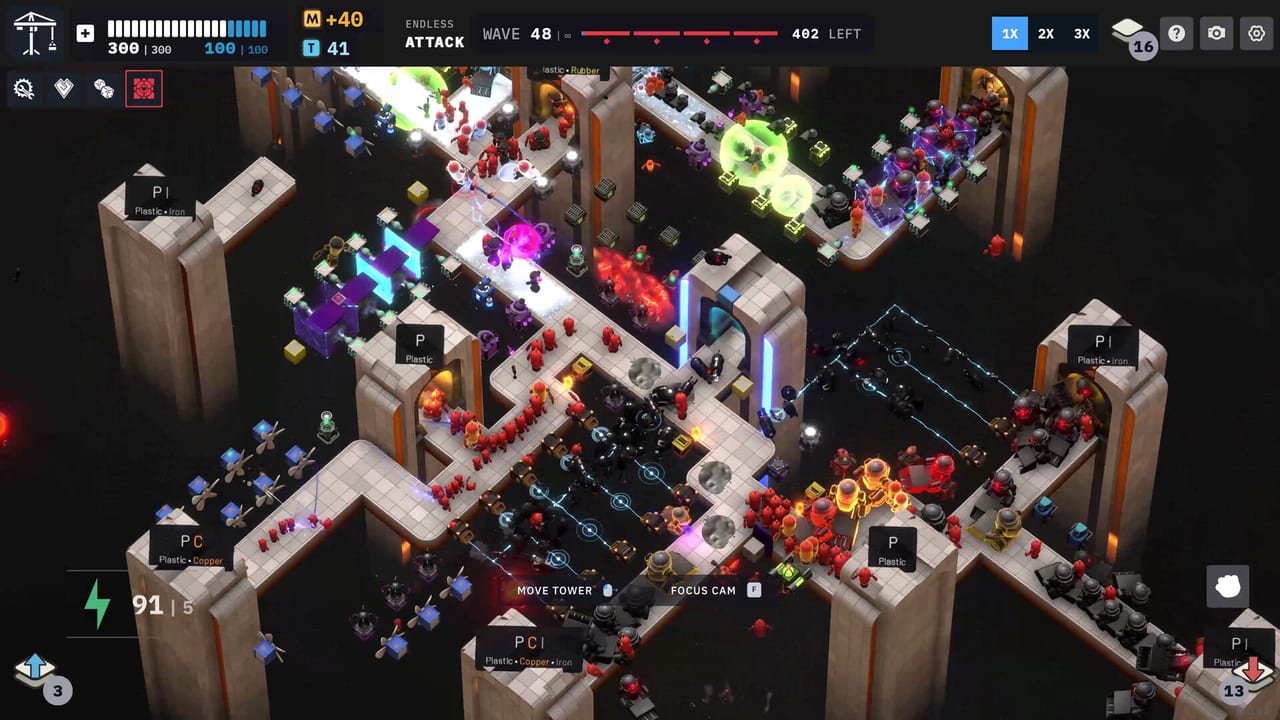
Tower Lab has no enemy health. There is no DPS spreadsheet hiding behind the HUD. A robot is a body with mass, material, and a path, and you win the wave by knocking that body off the floating lab. If it walks to the exit, you leaked, even if you “hit” it a hundred times.
Read this page after you can place a tower and press Start Attack. Pair it with the tower synergy chains and the Matter farming routes once you want to get paid for the mass you create. The complete tower roster is the name list when you need to remember which piece applies force, which stages a body, and which prints Scrap.
Steam Early Access is scheduled for September 7, 2026. These physics rules are the launch game, including in Endless and Standard TD. No mode secretly adds hit points.
Knockoff versus leak
The map is a lab in the sky. Off the edge is victory. The exit is defeat. Those two outcomes are not the same as “almost dead.” A robot that bounces, spins, and then finds its feet again is still a full threat. Your layout has to remove the walkable path, not chip a bar that does not exist.
Watch the last robot in a failed wave. Did it get small and slip through a Fan? Did it get huge and tank knockback until it waddled to the door? Did a projectile hit it upward when you needed sideways? Those are physics bugs in your build, not missing upgrades.
This Way traps illustrate the same idea. A passing enemy has a 10% chance to follow the sign forever. That is a routing tool, not a wall. Build as if most robots will ignore it, then enjoy the ones that do not.
Mass, Grow, and Shrink
Grow and Shrink are the risk/reward pair. Grown robots are worth more Matter. They are also harder to fling. If you Grow without a knockoff plan — Tesla on copper, Fan into a void, Gravity well into a cliff, Imploder grouping — you have built a richer leak.
Shrink does the opposite. Small bodies fly, but they also slip through poorly aimed wind and pay less at the shop. Shrink is a save button for a leaky lane, not a default economy plan. The correct sequence is usually: fatten what you can farm, shrink what you cannot hold, and never do both to the same body without a reason.
Merge and Split sit next to that pair. Merge stacks mass into fewer, heavier problems. Split turns one problem into many light ones. Either can win if the rest of the lab is built for that size. Bola, Cryo, and Flame change timing and traction so those size changes actually land. Imploder gathers. Deflector redirects. None of them “kill.”
Materials: Plastic, Iron, Copper
Bodies are tagged with Plastic (P), Iron (I), Copper (C), and combinations: PI, PC, PCI. Conductivity matters. Tesla prioritizes conductive materials, which is why a copper-heavy wave looks like a Tesla advertisement and a plastic-heavy wave does not.
Treat material as a targeting layer, not flavor text. Kinetic, Pulse, Bomb, Harpoon, and Rocket all interact with mass and bounce differently; none of them “counter plastic” the way a fire tower counters ice in a conventional game. You change the body, then you apply force.
Utility cards from patch notes exist to twist the same physics. Aftershock and Arc Discharge extend force after the first hit. Gravity Dampener cuts the gravity you might be stacking. Black Ice changes traction. Salvage and Hot Swap are economy and swap tools, not Region 1 openers after the starting-deck patch. If a card fights your Fan, it is not a free include.
Projectiles, wind, and production
Projectiles have travel time and knockback vectors. A Rocket that hits a grown iron body from the wrong angle can shove it toward the exit. A Mine wants a path, not a decorative corner. Harpoon is a grab. Bomb is an area impulse. Pulse and Kinetic are repeat force.
Fan is directional wind you can use to push or slow. Point it at the void you actually have. Gravity pulls. Production is still physics. Grinder converts robots into Scrap; you should build a Conveyor Line off its output instead of hoping Scrap teleports into the bank. Constructor belongs in a factory line, not in a decorative turret ring.
Stop hunting for a health bar that does not exist. Track mass, conductivity, and the nearest cliff. If a robot still has a walkable path to the exit, you have a physics problem, not a damage problem.
Frequently Asked Questions
Quick answers for new Tower Lab players.
Do enemies have health in Endless or Standard TD?
No. Every mode uses knockoff physics. Standard TD only changes when you may spend Matter. Endless changes the map and weekly modifier. Neither adds a hit-point bar.
Why does Grow make the shop richer and the wave harder?
Bigger and grown robots pay more Matter, but they resist knockback. Grow is an economy button that demands a cliff, Fan, Tesla, or Grinder plan. Without that plan it is a leak.
What do P, PI, PC, and PCI mean?
Material tags: Plastic, Plastic+Iron, Plastic+Copper, and Plastic+Copper+Iron. Tesla cares about conductivity. Read the tag before you assume a zap will throw the body.
Does Tesla work on every material equally?
No. Tesla zaps with high knockback and prioritizes conductive materials. Plastic-heavy waves need wind, gravity, or another force piece — not a bigger Tesla rank.
What does a Grinder actually produce?
Scrap, from ground-up robots. Build a Conveyor Line off the output. A Grinder with no line is a bin, not an economy engine. See the Matter farming routes for how that pays.
Is leaking the same as taking damage in other tower defense games?
Functionally it is how you lose the wave, but there is no chip damage on the robot. A body that still has a walkable path to the exit is at full threat until it leaves the lab.