
Tower Lab Matter Farming
Bigger knockoffs pay more. Safer knockoffs pay less. The shop is the whole argument.
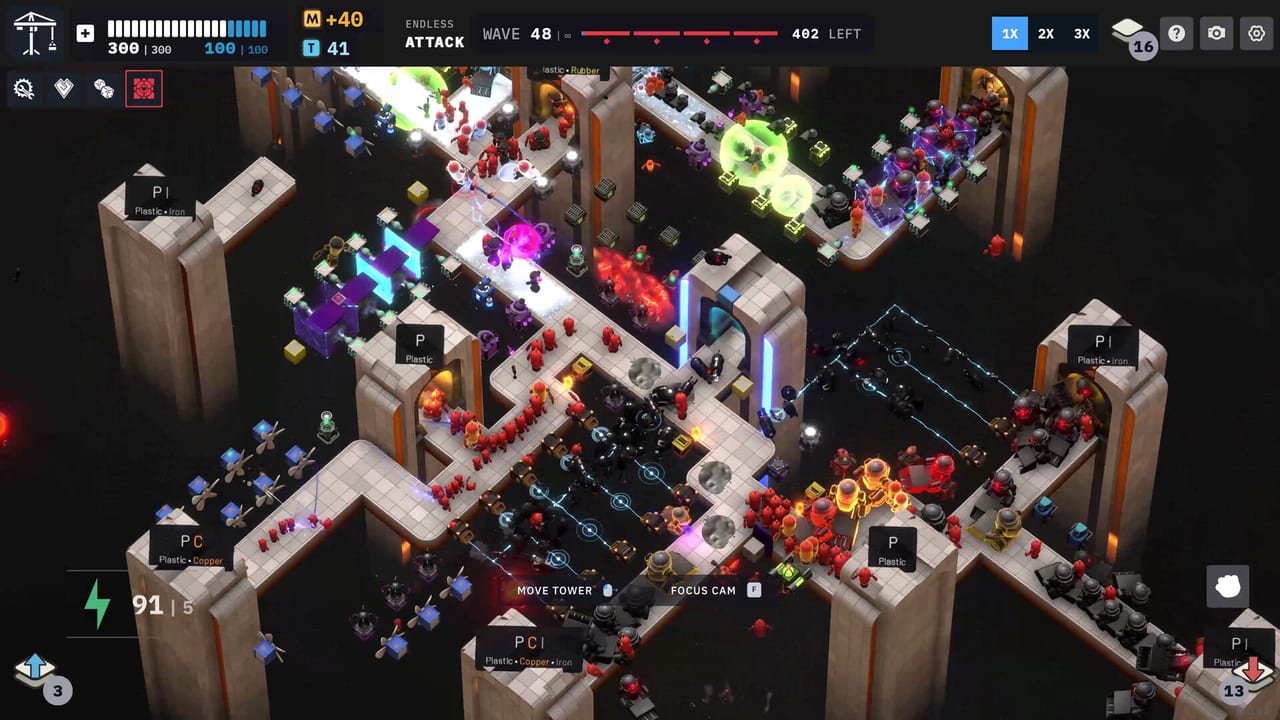
Matter (M) is the currency you earn when a robot leaves the map the hard way. There is no health bar to farm, no last-hit damage number, no gold per second from auras. You knock a body off a floating lab, and the game pays you for the mass you just yeeted. Grown and naturally huge robots pay more. Shrunk robots pay less. That single rule is the entire economy of Tower Lab, and it is why a “safe” Shrink deck can still lose the run in the Vend-O-Lab.
Steam Early Access is scheduled for September 7, 2026 as a single-player Windows and macOS build. These numbers and shop examples come from pre-launch play, including screenshot prices: Grinder M200, This Way trap M200, Fan M200, Tesla M400, remove-card M200 with limited uses, rerolls that can be free. Treat them as a budget lesson, not a patch-proof price list.
If you still think in DPS, read physics basics first. If you need a sentence to spend the Matter on, use starter decks. If you are ready to turn payout into tree nodes, open tower upgrades.
Matter is the only currency that matters
Three meters sit on the run, but they are not equal. Energy plays cards from the hand; without energy you cannot place the Grow that would have paid for itself. Tech points (T) deepen a tree after you right-click a tower. Matter is what buys the next card, the reroll, the removal, the tech upgrade in the shop, and the right to see the next level with a wave preview in hand.
Because payout scales with size, farming is a physics choice, not an idle tactic. A Gravity well that parks a grown robot for three extra seconds is an investment if you still knock it off. A Fan that clears a shrunk pack instantly is a leak in the ledger even if the pad looks clean. The builds hub exists to keep those two outcomes in the same sentence: clear the wave and fund the shop.
Knockoff, not kill. If a robot reaches the exit, you get nothing from it and you also failed the wave. Farming that greedily grows the pack until it walks out the door is not farming. It is a donation to the exit.
Grow for payout versus Shrink for safety
Grow increases size and mass. Shrink decreases them. Both are towers on the twenty-card roster, and both can target robots or projectiles depending on how you aim the chain. The store pitch is honest: shrink to make bodies easier to push, or risk growing them for increased rewards. Grow projectiles if you want the tool that hits them to hit harder in physical terms.
Safety plan: Shrink early, Fan or Tesla the cheap bodies off, accept a lean shop. This is Wind Orbit’s default mood on starter decks. Use it when the wave preview looks ugly, when you are one leak from ending the run, or when you still need to learn the pad.
Payout plan: Grow on a controlled lane, then finish with Grinder, Imploder, Bomb, or a trap-aimed corridor. Scrap Line likes this because teeth care less about mass than fans do. You must still point the fat bodies at an edge. A grown robot in the middle of the pad is a monument to greed.
Hybrid plan: Shrink the front of the pack so the Fan can work, Grow a backliner you have already trapped with Bola, Gravity, or This Way. You are tagging loot, not buffing the entire wave. If you cannot isolate a body, do not Grow.
Copper, Rubber, and Iron shells from later waves change which force is cheap. Electrical knockback and mass are not the same lever. If Tesla is absent because Region 1 no longer starts with it, do not Grow a pack you can only tickle with a lonely Kinetic. Match the payout tool to a finisher you already placed.
Vend-O-Lab prices and the remove-card tax
The shop is where farming becomes a build. Example screenshot prices:
- Grinder: M200
- This Way trap: M200
- Fan: M200
- Tesla: M400
- Remove card: M200, limited uses
- Reroll: sometimes free
- Tech-tree upgrade: paid in the same currency family
- Next level: leave when the wave preview says you are ready
A grown-wave farmer who skips remove-card will drown in extra verbs. Limited removals mean you plan the delete before you click Grow. If Shrink is fighting your Grinder, that is the M200 you spend. If you are holding a vanity Rocket in a Fan deck, that is the M200. Do not spend the limited delete on a card you might need on the weekly Endless tag.
Free rerolls are for shaping, not for gambling Tesla every time. Tesla at M400 is a premium. Bank for it when Conductive Knockback is the plan; otherwise Fan or Grinder at M200 probably finishes the sentence you are already speaking. Incoming wave preview is part of the shop UI: if the next pack is huge, buying Grow without a finisher is how farmers leak.
Tech points bought here are not free power. They lock you into a tree. Farm first, then deepen the tower that actually knocked mass off the map, using the upgrades guide as the menu.
Spending mid-wave in Standard TD
Standard TD is the arcade mode for people who want a more traditional tower-defense clock with a physics twist. You may build in the middle of the wave with Matter. That turns farming into a live market. Knock off a grown robot, buy the Fan, place it before the next portal cycle, knock off more.
Implications:
- You can Grow, cash, and immediately buy the tool that makes Grow safe.
- You can also overspend mid-wave and have no energy alignment for the new card.
- Placement still has no grid prison: any open space, move freely, even while the pack is live if the mode lets you.
- Simulate and speed controls (1X / 2X / 3X) are how you test a mid-wave purchase without guessing.
Campaign is stingier. Matter earned in a stage waits for the Vend-O-Lab. Farming there is a between-stage plan: grow this stage to afford Tesla next shop, not to impulse-buy during the leak. Puzzle rarely cares about long-run income. Workshop lets you sandbox the Grow-to-edge machine without a campaign core at risk.
Endless scaling and weekly maps
Endless uses a procedurally expanding map and scaling threats. Older playtests put shop access on a wave interval and inflated enemy mass over time. Weekly setups such as Overmass exist to make “always Shrink” a trap. If everything is already huge, Shrink is a discount you buy with energy, and Grow may be redundant or suicidal.
Farming in Endless is a survival tax. You need Matter for the next shop interval more than you need a pretty pad. Scrap Line and other contact plans scale into fat bodies better than a pure Wind Orbit. Keep a remove-card in reserve for the utility that made sense on wave 5 and fights you on wave 25.
Leaderboards will record how far a farming engine survived, not how stylish the Grow was. If Overmass is the week, practice grown knockoffs in Workshop before you stake the run.
Farming without griefing your own edges
Practical rules you can say out loud:
- Never Grow a robot you cannot name a finisher for.
- Never Shrink the whole wave if the next shop needs M400.
- Count example staples: two M200 cards equal one Tesla. That is the Grow target for a Conductive pivot.
- Use wave preview. If the pack is already huge, you are in an Overmass mindset even in Campaign.
- Move towers. A Gravity well that farmed wave 2 may trap payout on wave 4. Slide it to the edge.
- Energy is the hidden cost of farming. A Grow you cannot play is not an economy.
The physics basics page is the force dictionary. This page is the ledger. The starter decks page is the sentence you fund. When Early Access opens on September 7, 2026, write down one number after each shop: Matter in, cards bought, removals left. If income fell while the pad looked “easy,” you shrunk the payout. If income spiked and then a fat pack walked out the exit, you farmed the wrong edge. Matter in Tower Lab is mass you were brave enough to finish.
Frequently Asked Questions
Quick answers for new Tower Lab players.
Why do bigger robots drop more Matter?
Tower Lab pays for knockoffs by size and growth, not for damage. Grown or naturally huge bodies are worth more when they leave the map. The risk is that they are also harder to push, which is the whole lesson on physics basics.
Should I always Shrink for safety?
No. Shrink-only decks starve the Vend-O-Lab. Tesla sits around M400 in example shops while Fan and Grinder sit around M200. You need a payout plan from starter decks if you intend to buy premium cards.
Can I spend Matter during a wave?
In Standard TD, yes: that mode lets you build mid-wave with Matter. Campaign spends between stages in the Vend-O-Lab. Endless spaces shops across scaling waves. Confirm the mode in the campaign walkthrough.
Is remove-card part of farming?
Yes. Example cost is M200 with limited uses. Deleting a card that fights your Grow or Fan is often a higher return than buying a fourth copy of a tower you already cannot energy-play. Spend the delete using the upgrades plan so the remaining cards match the tree you fund.
How does Endless Overmass change farming?
Weekly maps such as Overmass inflate mass. Shrink becomes a costly discount and Grow can be redundant. Contact plans like Scrap Line on starter decks usually keep paying when everything is already huge.