
Tower Lab Campaign and Modes
Campaign, Standard TD, Endless, Puzzle, and Workshop — plus regions and hazard cores.
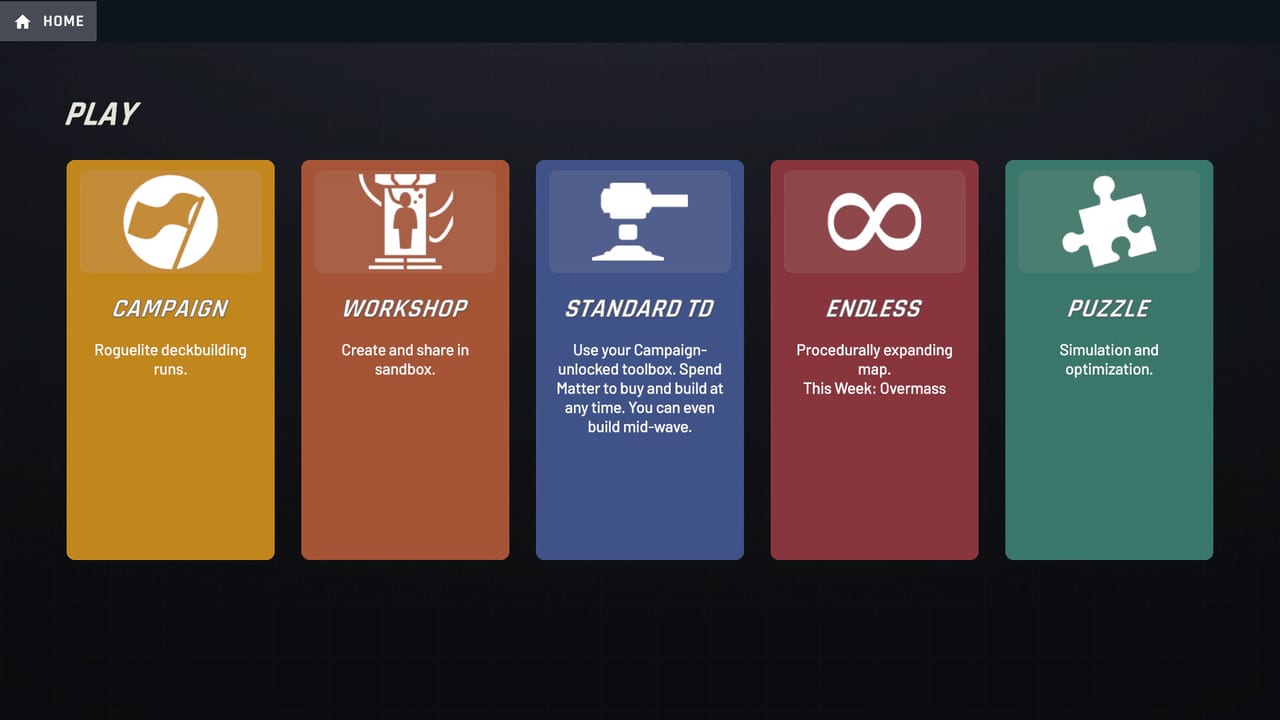
Tower Lab ships five modes, not one campaign with four extra buttons. Steam Early Access on September 7, 2026 is the planned window to play them as a set. The Early Access store list is the launch target: 3 campaign regions, 26 player cores plus 14 Hazard Cores, and the five playlists below. The January 23–June 29, 2026 demo collection showed a slightly smaller set of cores, machines, and traps; use those numbers as an earlier snapshot, not as the launch spec.
Campaign is where most players should live first. The other four modes exist so you can practice a skill Campaign only teaches under pressure. Pair this page with the Early Access launch notes and the content roadmap when you need dates instead of tactics. For a first deck that survives Region 1, steal from the starter deck examples.
The game stays single-player in every mode. Workshop sharing and leaderboards do not put a second person in your lab. It is not a Roblox experience.
Campaign — roguelite deckbuilding
Campaign is the spine. Small deck, wave hands, energy spends, Vend-O-Lab between stages, three regions. You are drafting a physics engine, not filling a loadout screen.
Hazard Cores are the difficulty injectors. Player cores (26 on the launch list) change how you play; Hazard Cores (14) change how the lab fights back. Treat a Hazard Core like a run modifier you opted into, not like a graphics preset. If a core makes mass worse, your Grow line might become a leak line.
Region 1 is the teaching region. A patch already removed Tesla, Salvage, and Hot Swap from its starting deck, which tells you the designers do not want a Region 1 Tesla autopilot. Buy control and economy first. Regions 2 and 3 exist to stretch the same loop across new labs and nastier modifiers, not to unlock a hidden lobby.
Early Access is planned for about six to twelve months. The team has said the price is planned to rise about 25% after 1.0. This wiki does not invent a current dollar price; check Steam on launch day. Official discussion lives on Discord. There is no Trello board listed here because the studio has not published one for this wiki to copy.
Standard TD — unlocked toolbox, spend anytime
Standard TD is the “I already know the cards” mode. You play with a campaign-unlocked toolbox and you can spend Matter anytime, including mid-wave. That is the opposite of Campaign’s shop-between-stages discipline.
Use Standard TD to test a layout that Campaign would punish you for tinkering with during a live wave. It is still physics, still no health bars, still a leak if a robot reaches the exit. The difference is economic timing: you may buy the missing Fan while the wave is already walking, which makes it a lab notebook more than a roguelite.
Do not treat Standard TD as the “real” game and Campaign as a tutorial. Campaign is the designed deck loop. Standard TD is the unlocked toolbox for experiments once Campaign has taught you the names.
Endless — expanding map, weekly modifier
Endless grows the map procedurally. The weekly modifier is the headline; Overmass is the example players already use as shorthand. Overmass means the bodies you face are heavier than your default knockoff plan. Grow becomes greed. Shrink and high-impulse offense become the save.
Do not bring a Campaign comfort deck into Overmass and expect the same cliffs to work. Recheck Fan angles. Recheck Tesla targets. Recheck whether your Grinder line still catches bodies that no longer fly. A weekly modifier is a physics rewrite, not a score multiplier painted on the same wave.
Endless is still single-player. The expanding map is the opponent.
Puzzle — Simulate as the skill
Puzzle is simulation and optimization. The HUD’s Simulate button is the point, not a convenience. You are here to prove a layout with as little waste as possible: fewest cards, cleanest knockoffs, no leaks.
If Campaign feels noisy, Puzzle is where you learn why a Deflector one tile left saves the run. Speed 1X, watch collisions, then lock the answer. You are optimizing against the lab, not against another defender. Photo mode is useful here when a solution is worth keeping.
Workshop — sandbox you can share
Workshop is the sandbox. Build a contraption, share it, steal a factory line, break a lab on purpose. Constructor, Grinder, conveyor belts, This Way signs, and silly Grow stacks belong here before you bet a Campaign region on them.
Workshop is also where photo mode earns its keep. Capture the machine, then go prove it in Campaign or Standard TD. Sharing a level is not the same as running the lab with someone else. You still press Start Attack alone.
After Region 1, pick the mode that trains the skill you actually missed: Standard TD for toolbox experiments, Endless for overmass pressure, Puzzle for Simulate mastery, Workshop for sharing a contraption you actually want to keep.
Frequently Asked Questions
Quick answers for new Tower Lab players.
Which mode should I play first?
Campaign. It teaches the deck loop, the Vend-O-Lab, and the three regions. Open Standard TD, Endless, Puzzle, or Workshop after you know why a skipped card is sometimes correct.
How many regions are in Campaign at launch?
Three on the Early Access store list. Region 1 is the teaching region. Regions 2 and 3 stretch the same physics across new labs and modifiers.
What is a Hazard Core?
A difficulty injector. The launch list has 14 Hazard Cores and 26 player cores. Player cores change your tools; Hazard Cores change how the lab fights back. They are not graphics presets.
What is Overmass in Endless?
A weekly modifier example where bodies are heavier than your default knockoff plan. Grow becomes risky. Shrink, wind, and high-impulse offense become the tools that still throw mass off the lab.
Is Workshop a multiplayer mode?
No. Workshop lets you build and share sandbox labs. You still run the simulation alone. Tower Lab is single-player in every playlist.
Did the demo include every launch core, machine, and trap?
No. Demo collection screens showed a slightly smaller set. Prefer the Early Access store numbers for launch: 26 player cores, 14 Hazard Cores, 7 traps, and 5 machines, plus 20 towers with 150+ upgrades.